
Parliament on Thursday cleared the decks for the rollout of the historic Goods and Services Tax from July 1 as it approved four supporting legislations to usher in the one-nation-one-tax regime.


The empowered committee of state finance ministers has approved the position paper of the Centre on the information technology network for the proposed indirect tax regime.

With indications that government is keen to allow foreign airlines buy stakes in Indian carriers, a Group of Ministers (GoM) is likely to meet next week to decide on the investment cap by them, official sources said on Friday.
Your tax burden has just gone up, with the government issuing the new guidelines for taxation of perquisites. Valuation of cars goes through a revision.
The Twelfth Finance Commission chairman C Rangarajan said on Tuesday that he was in favour of an early implementation of the value added tax regime.

Addressing the Lok Sabha on Wednesday, Finance Minister Pranab Mukherjee called for the inclusion of petroleum products in proposed goods and services tax so that sharp domestic price movements can be checked.
Your tax burden has just gone up, with the government issuing the new guidelines for taxation of perquisites. Valuation of cars goes through a revision.
He also said that the expert committee on amendments to the Income-Tax Act was expected to submit a draft Bill during the early part of 2006, but did not give any time-frame for the introduction of amendments.
Seeking to allay fears of the trading community, the Empowered Committee on Value Added Tax on Thursday said there would no 'inspection raj' when the new state-level tax regime comes into effect from April 2005.
'This mega corruption scandal, as certified by the Supreme Court, will expose the unholy nexus between the BJP and its corrupt corporate masters'

TVs, air conditioners, washing machines, inverters, refrigerators, electric fans and cooking appliances may become cheaper

Anil Rego, CEO, Right Horizons, answers your personal income tax queries.

To improve compliance, govt may introduce lottery reward for filing GST. The Consumer Welfare Fund, where anti-profiteering proceeds are deposited, will be used to reward the lucky winners on monthly and annual bases. The prize money, yet to be fixed, may run into several lakhs of rupees for the annual draw, and about Rs 50,000 for monthly draws.

The Income Tax Department on Wednesday raided the homes and offices of Bollywood actor Taapsee Pannu and filmmaker Anurag Kashyap as well as his partners who launched the now shuttered production house Phantom Films, officials said.

'The rising cost of construction, the cost of doing business, high compliance, and inflation/interest rates going up have already reduced returns to single digits.'

'Through the use of technology, the GSTN will tip the balance in favour of compliance rather than tax evasion, lowering the barriers for entry into the tax payment system while making it much harder to cheat on payments,' says Nandan Nilekani.
In a major step towards introduction of Value-added Tax from April 2005, states on Wednesday endorsed a 'white paper' on the new tax regime, which would be formally issued on January 17.

The fiscal gains from implementing the GST and demonetisation, while almost certain to occur, will probably take time to be fully realised

The new Land Acquisition Act to provide just and fair compensation to farmers came into force from January 1, 2014.
Exemption from minimum alternate tax for REITs & infrastructure investment trusts; Depository receipts on all securities eligible for tax benefit
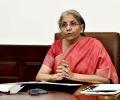
Amid record-high fuel prices, Finance Minister Nirmala Sitharaman on Monday said there is no proposal as of now to bring crude oil, petrol, diesel, jet fuel (ATF) and natural gas under the Goods and Services Tax (GST). When the GST was introduced on July 1, 2017, amalgamating over a dozen central and state levies, five commodities - crude oil, natural gas, petrol, diesel, and aviation turbine fuel (ATF) - were kept out of its purview given the revenue dependence of the central and state governments on this sector. This meant that the central government continued to levy excise duty on them while state governments charged VAT. These taxes, with excise duty, in particular, have been raised periodically.

A record GST tax collection, an overhaul of the income tax return filing portal and the landmark move to scrap retrospective taxation have set the stage for the next level of reforms in tax administration that include bringing a framework for cryptocurrencies and rationalising the GST rate structure. With tax reforms such as faceless assessment taking roots, 2021 will go down as the year that pivoted the tax administration in a country aspiring to become the world's favourite investment destination. The task ahead is going to be a tough one as the tax department would grapple with taxing cryptocurrencies, rationalising Goods and Services Tax (GST) rates to shore up revenues and post June 2022, the scenario of how the GST revenue plays out for states without the Centre's support of compensation.

The alpona (artwork) on the steep, winding road leading to Makaibari bears testimony to the visit of G20 delegates for the second tourism working group meeting in April last year. The lush tea bushes, the delegates joining in for the moonlight plucking of Silver Tips Imperial first flush, a favourite of late Queen Elizabeth II, cut a picture of mystical magic. But it's not the Kurseong tea garden's only shining moment - the last few years have been busy for the estate and its bungalow.

If the government decides to go back to the old regime where the EPF was not taxed but the NPS was, the latter will become an unattractive product.

Pranay Bhatia offers insights on some key issues from Nirmala Sitharaman's maiden Budget.

Experts share their views on the steps that will help businesses become GST-ready.
The empowered committee on value-added tax will meet the finance minister in mid-July to discuss the 'roadmap' for the introduction of the new tax regime, after which it will be taken up with political parties for a national consensus.

The CBEC will itself be rechristened as the Central Board of Indirect Taxes and Customs and will supervise GST and Customs activities and provide the government policy inputs.
